Scent-Sational Advancement in Canine Research!

Bar-Ilan University study reveals insights into dogs’ olfactory systems that could pave the way for new applications in law enforcement, healthcare, and rescue operations

A pioneering study investigating the brain activity of dogs during scent detection has unveiled crucial insights into their remarkable olfactory capabilities. Researchers at Bar-Ilan University in Israel have developed an optical sensor capable of remotely sensing dogs’ brain activity in three key regions— the olfactory bulb, hippocampus, and amygdala— that play a critical role in how dogs distinguish between different smells. This breakthrough could lead to the development of a compact, non-invasive device capable of interpreting and translating a dog’s olfactory perceptions for human understanding. In the study, scientists employed a cutting-edge detection structure system using laser technology and a high-resolution camera to capture brain activity in real-time from four dog breeds. These dogs were exposed to four distinct scent stimuli—garlic, menthol, alcohol, and marijuana. The data were then analyzed using a machine-learning algorithm revealing that the amygdala plays a significant role in scent differentiation, highlighting the emotional and memory-related aspects of odor processing.
Full Story

The Art of Tracking Invisible Patterns in Animal Behavior

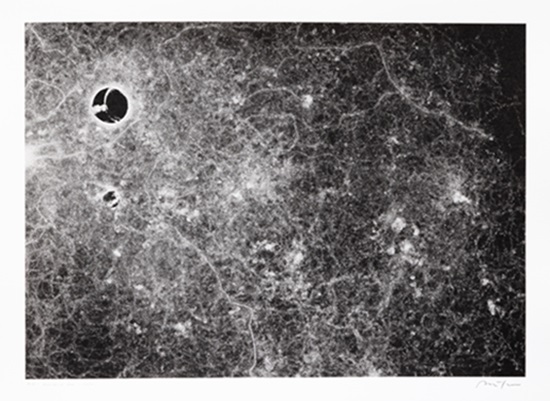
In the Kronauer lab, Pruefer placed entire colonies of clonal raider ants on his canvasses and allowed them to move over these surfaces for hours or even days. “In the end, it’s like a narrative of their movements and what they’ve done over that whole time” says Pruefer, who has been experimenting with this technique for over a decade.

Anyone stepping into a gallery featuring Maximilian Pruefer’s work might mistake the intricate patterns on the walls for imagery from a scientific symposium. The 38-year-old German multimedia artist has spent years capturing the unseen movements of animals, rendering their invisible world visible. Using innovative techniques, he records fleeting interactions—most recently, those of ants—transforming their behavioral traces into striking visual compositions. The pursuit of uncovering hidden narratives in nature brought him to The Rockefeller University, where he spent six weeks in the Laboratory of Social Evolution and Behavior as an artist-in-residence. The lab is led by Daniel Kronauer, PhD, the Stanley S. and Sydney R. Shuman Associate Professor, who studies the evolution of complex insect societies, using ants as a model to explore how social behavior is regulated—from genes and neural circuits to colony-wide interactions. The two were introduced by a mutual friend, and Kronauer immediately saw a connection.

Full Story

Study Uncovers Secret UV Color Language of Snakes

In the study of why and how animals look the way they do, color is king—at least, the range of color humans can see. A University of Michigan (U-M) study examined a color range that humans can’t see and often ignore: color in the ultraviolet range. Examining snakes, the researchers categorized how the animals used patterns of UV color and tested for factors that promote the evolution of UV color in snakes. The researchers discovered that UV color is found widely across the snake tree of life, and that it is frequently used for predator avoidance, says study co-author Hayley Crowell, a doctoral student in the U-M Department of Ecology and Evolutionary Biology. The study, published June 18, 2024 in Nature Communications, also highlights how researchers might be ignoring the way a whole group of organisms might be using color. The open-access article is titled “Ecological Drivers of Ultraviolet Colour Evolution in Snakes.”

Full Story