

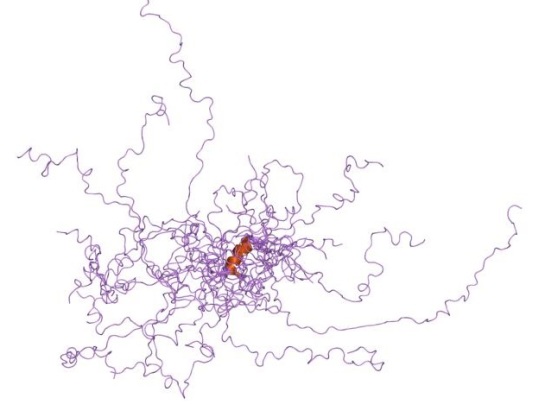
 Proteins carry out almost all processes in living organisms, including moving other molecules from one place to another, replicating DNA, conveying genetic information from genes to cells, controlling immune response, driving metabolism, and building muscle. Not all protein molecules are created equal, however, and some are better understood than others. Now, a team of scientists led by a Johns Hopkins University biologist has cracked a key part of the mystery surrounding a particular group of proteins that emerged as a distinct type less than 30 years ago. The finding, reported on October 12, 2017 in the online journal eLife, could eventually lead to treatments for diseases that range from cancer to neurological disorders. The title of the article is “Genetically Tunable Frustration Controls Allostery in an Intrinsically Disordered Transcription Factor.” Dr. Vincent Hilser, Professor and Chair of the Johns Hopkins Department of Biology, said it’s not possible to say when this new research will translate into improved treatments, “but what is clear is understanding how these things work is a critical step toward that.” These so-called “intrinsically disordered proteins” (IDPs) do not look like the more familiar type, but they make up about 40 percent of all proteins. Perhaps more importantly, they constitute the majority of proteins involved in the process called “transcription.” That’s how the instructions in the DNA genetic code are converted to messenger RNA that codes for the production of proteins in the ribosomes. It is not clear exactly how errors in transcription affect human health, but it is known that these errors are involved in most cancers, Dr. Hilser said. “It’s probably going to be the case that to understand many, if not most, cancers, you’re going to have to understand disorder,” he said, meaning disordered proteins.
Until the early 1990s, scientists only knew of “structured” proteins, existing as unique shapes that respond when a regulator molecule binds to them, changing their shape and controlling their function. These protein molecules have been compared to origami creations folded into a particular shape.
Anything showing up in experiments that did not fit that profile was often dismissed as some problem with the experiment, or an anomalous form that was not biologically significant.
These outliers have since been recognized as a legitimate form of protein, although given a somewhat disparaging name. They don’t fold up; they don’t assume any unique shape at all other than strands of “spaghetti,” as Dr. Hilser puts it. Hence the term “disorder” in the name, as opposed to “structured” proteins – and part of the mystery.
If the structure is the mark of the regulating molecule doing its work (determining protein activity and function), then what to make of proteins that do not do that? What controls the activities of these shapeless strands?
The scientists in the current work, nine from Johns Hopkins and one from the University of Houston, set out to answer the question. They chose for their study a disordered protein taken from human cells called glucocorticoid receptor, which regulates genes that control, among other functions, metabolism and immune system response.
By manipulating segments of the protein in the lab, the scientists were able to show how one portion acts on another, and that the disordered protein creates versions of itself to act almost in place of regulator molecules that govern its activity. The disordered protein uses an activation-repression dynamic between sections within the disordered chain to regulate its own activities and those of other proteins.
In this way, an IDP may allosterically control function by simultaneously tuning transcriptional activation and repression, using a novel strategy that relies on the principle of “energetic frustration.” The scientists demonstrated that human glucocorticoid receptor tunes this signaling in vivo by producing translational isoforms differing only in the length of the disordered region, which modulates the degree of energy frustration. The scientists wrote that they expect this frustration-based model of allostery will prove to be generally important in explaining signaling in other IDPs.
“Our work uncovered the language of how these spaghetti pieces communicate,” Dr. Hilser said. “We showed that those pieces of spaghetti interact with each other sort of like attracting and repulsing magnets, creating a kind of ‘tug-of-war,’ and that the body can make different versions of the protein to tune which part wins the tug of war.”
Yet to be explained, he said, is how the interactions among these proteins and the sub-sections happen and how all this can ultimately be used to treat disorders that emerge when things go awry with these molecules central to almost all life function.
[Press release] [eLife article]