Researchers at Juntendo University uncover a lipid signaling pathway that helps epithelial cells respond to membrane injury


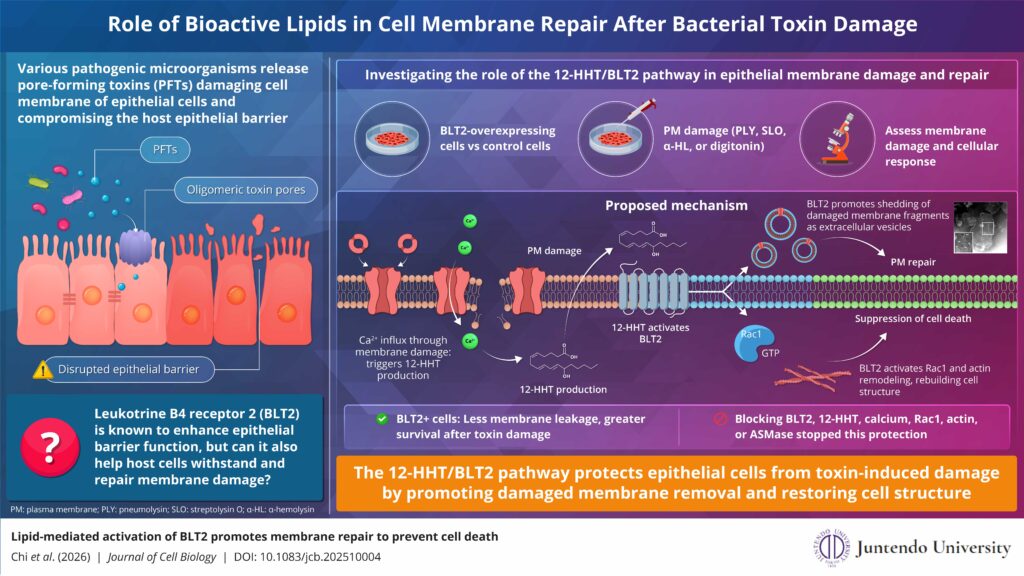
Epithelial cells form the body’s frontline barriers, helping keep microbes, toxins, and other harmful substances out. Yet these protective cells are constantly exposed to threats, including microbial infections. Some bacteria produce pore-forming toxins that can oligomerize and act like microscopic drills, perforating the cell’s plasma membrane. If these pores are not repaired quickly, cells can lose vital contents, suffer internal damage, and eventually die. Understanding how epithelial cells rapidly repair toxin-induced membrane injuries is therefore important for understanding how tissues withstand bacterial attacks. To investigate how cells respond to this damage, researchers Dr. Yuan Chi, Dr. Kazuko Saeki, and Professor Takehiko Yokomizo, MD, PhD, at Juntendo University in Japan, and colleagues focused on a signaling system involving 12-HHT, a bioactive lipid mediator, and BLT2, a receptor found primarily on epithelial cells. They investigated how lipid mediator signaling promotes plasma membrane repair and protects cells from membrane-damaging insults. The study was published online in the Journal of Cell Biology on September 3, 2026. The article is titled “Lipid-Mediated Activation of BLT2 Promotes Membrane Repair to Prevent Cell Death.” See image at end.
The researchers used human lung epithelial cells, canine kidney epithelial cells, and primary mouse skin epidermal keratinocytes, comparing cells with natural, increased, or absent BLT2 expression. They induced membrane damage using pneumolysin, streptolysin O, α-hemolysin, or digitonin and assessed membrane injury, leakage, and cell survival through microscopy, fluorescent dyes to assess membrane integrity, LDH-release assays, and viability tests. Electron microscopy was used to examine cells and extracellular vesicles. To investigate the mechanism, the team tested calcium-free conditions, measured 12-HHT levels by liquid chromatography–mass spectrometry, and used inhibitors targeting BLT2, Rac1, actin polymerization, acid sphingomyelinase, and 12-HHT production.
They found that BLT2 helps epithelial cells survive after their membranes are damaged. Under these conditions, cells with enhanced BLT2 signaling showed less membrane leakage, less visible damage, better mitochondrial health, and higher survival rates. In contrast, cells lacking BLT2 were more likely to rupture and die. BLT2’s benefit was seen with all the tested toxins as well as with digitonin, suggesting that it is part of a general membrane-repair system. “These findings identify the 12-HHT/BLT2 axis as a previously unrecognized regulator of the cellular response to plasma membrane damage,” shares Dr. Chi.
The study showed that BLT2 does not stop toxins from attaching to the cell. Instead, it helps cells respond after injury. Calcium influx through membrane holes triggered production of 12-HHT. The 12-HHT then activated BLT2 and launched two major repair actions. First, BLT2 helped cells pinch off damaged pieces of membrane, including toxin pores, into tiny bubbles called extracellular vesicles. Second, BLT2 activated Rac1, which reorganized actin, the cell’s internal support framework, to strengthen and reshape the injured cell. Blocking either vesicle release or Rac1-driven actin repair removed BLT2’s protective effect.
Dr. Chi notes, “By identifying the 12-HHT/BLT2 pathway as a regulator of plasma membrane repair, our research highlights that in addition to targeting the pathogen or toxin, it may also be possible to enhance the ability of host cells to withstand and repair membrane damage.” In the long term, this knowledge could contribute to the development of host-directed therapeutic approaches for infectious diseases and other conditions associated with plasma membrane injury.
In conclusion, the study identifies the 12-HHT/BLT2 pathway as an emergency membrane-repair system that helps epithelial cells remove damaged membrane, restore their internal structure, and survive bacterial attack. The discovery provides new insight into how cells protect themselves after their first line of defense, the plasma membrane, has been breached.
About Dr. Yuan Chi from Juntendo University
Firat author Dr. Yuan Chi is a researcher at Juntendo University Graduate School of Medicine, Japan. She holds a PhD and subsequently pursued postdoctoral research at Juntendo University. Her research has encompassed cell biology and molecular signaling, including oxidative stress, connexin 43 signaling, inflammatory pathways, lipid mediators, and the biological functions of the BLT2 receptor. Dr. Chi has authored or co-authored 26 scientific publications. Her work was recognized with a Poster Award at the 62nd International Conference on the Bioscience of Lipids (ICBL) in 2022.
History of Juntendo University
Juntendo was originally founded in 1838 as a Dutch School of Medicine at a time when Western medical education was not yet embedded as a normal part of Japanese society. With the creation of Juntendo, the founders hoped to create a place where people could come together with the shared goal of helping society through the powers of medical education and practices. Their aspirations led to the establishment of Juntendo Hospital, the first private hospital in Japan. Through the years, the institution’s experience and perspective as an institution of higher education and a place of clinical practice has enabled Juntendo University to play an integral role in the shaping of Japanese medical education and practices. Along the way, the focus of the institution has also expanded, now consisting of nine undergraduate programs and eight graduate programs; the university specializes in the fields of health science, health and sports science, nursing health care and sciences, and international liberal arts, as well as medicine. Today, Juntendo University continues to pursue innovative approaches to international level education and research with the goal of applying the results to society. [News release] [Journal of Cell Biology abstract]