

Multidisciplinary approach combining mouse models, novel cell engineering and cryo-ET reveals that RNF213 attaches ubiquitin directly to dysfunctional glycogen to trigger autophagy
Ubiquitylation is a key regulatory process in cells, during which the small protein ubiquitin is attached to a substrate to control its fate. It was once believed that only proteins underwent ubiquitylation, until Felix Randow’s group, based in the MRC Laboratory of Molecular Biology (LMB)’s PNAC Division, demonstrated that cells use the enzyme RNF213 to attach ubiquitin to lipopolysaccharide (LPS), a non-protein component of invading bacteria. This finding established non-protein ubiquitylation as a new mechanism of immune defense and raised the intriguing possibility that other non-protein molecules might also be targeted by ubiquitin. Felix’s group has now discovered that RNF213 also attaches ubiquitin to abnormal glycogen deposits, highlighting the important role that non-protein ubiquitylation plays in maintaining normal physiology in animals.
Glycogen is a large, highly branched polysaccharide made from glucose that cells use to store energy. When branches of glycogen don’t form correctly, it becomes poorly soluble and can amass in deposits called polyglucosan bodies, the accumulation of which causes several serious diseases. How exactly cells identify and remove abnormal glycogen has, so far, not been well characterized.
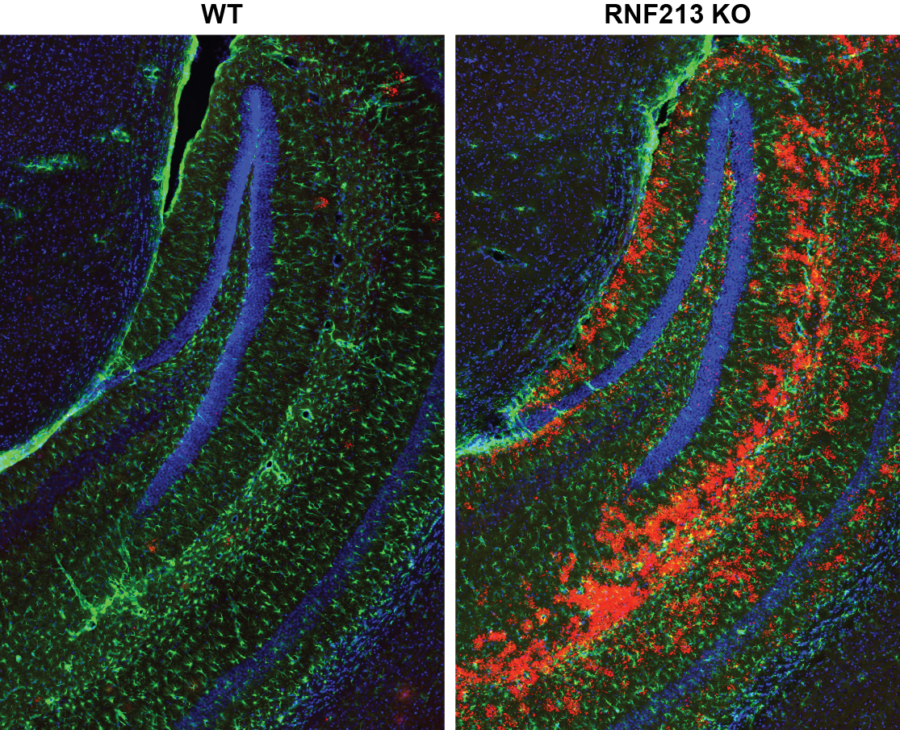
To investigate whether ubiquitylation helps cells recognize abnormal glycogen, Matthew Yip, a postdoc in Felix’s group, asked if the RNF213 enzyme also had an important role in glycogen quality control. Working with Andrew McKenzie’s group, also in the LMB’s PNAC Division, and the LMB’s Transgenics, Genotyping and Biological Services facilities, mice lacking RNF213 were generated and examined over several months. These mice accumulated prominent polyglucosan bodies in specific regions of the brain, demonstrating that RNF213 is required to prevent the accumulation of abnormal glycogen.
To understand the role of RNF213, Matthew devised a new experimental system that switches cells from producing normal, highly branched and soluble glycogen to the poorly branched, abnormal form that accumulates in disease. This system allowed the group to watch glycogen quality control in action. They found that RNF213 specifically accumulates on abnormal glycogen, where it affixes ubiquitin directly, kickstarting the cell’s recycling process, which delivers the abnormal glycogen to lysosomes for disposal.
The team then worked with Wanda Kukulski’s group at the University of Bern to visualize this clearance process inside cells. Using cryo-electron tomography (cryo-ET), they captured polyglucosan enclosed within double-membrane autophagosomes, providing a striking view of how cells package abnormal glycogen for delivery to lysosomes and degradation.
This study establishes non-protein ubiquitylation as an important mechanism of cellular quality control that helps maintain tissue homeostasis. Ubiquitin not only controls the fate of proteins, organelles, and invading pathogens, but can also be attached directly to an endogenous non-protein biomolecule, in this case glycogen, to mark abnormal material for disposal. Together with the Randow group’s previous discovery that RNF213 ubiquitylates bacteria during infection, these findings reveal non-protein ubiquitylation as a broader branch of ubiquitin biology than previously appreciated. Remarkably, RNF213 employs the same fundamental strategy to protect cells against two very different threats: invading bacteria and abnormal glycogen. By uncovering how cells recognize and eliminate abnormal glycogen, the study also sheds new light on serious disorders such as Lafora disease, Andersen disease, and Adult Polyglucosan Body Disease, all of which are characterized by the accumulation of polyglucoson bodies.
The work was published September 15, 2026 in Nature. The article is titled “Quality Control of Glycogen Through Direct Ubiquitylation by RNF213.”