

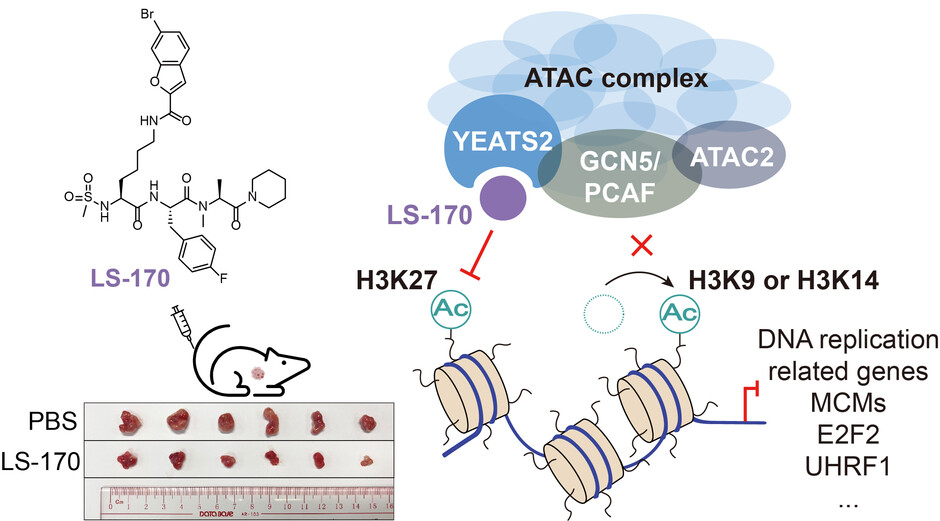
A research team led by Professor Xiang David Li from the Department of Chemistry at The University of Hong Kong (HKU), in collaboration with researchers from the Shenzhen Bay Laboratory and Tsinghua University, has made a breakthrough in epigenetic drug discovery. The team has successfully developed a first-in-class chemical inhibitor that precisely and selectively targets the ATAC complex, a critical cellular “switch operator” that activates tumor-promoting genes, opening a novel therapeutic avenue for non-small cell lung cancer (NSCLC). The findings were published January 9, 2026 in Nature Chemical Biology, and multiple international patent applications have been filed. The article is titled “Complex-Specific Inhibitors for Interrogating ATAC Histone Acetyltransferase Complex.”
Histone Modifications As Genetic Switches in Our Cells
Inside human cells, DNA is wrapped around protein structures called histones to form chromatin. Chemical modifications on histones function like genetic “switches,” determining whether genes are turned on or remain silent. Among these modifications, histone acetylation is one of the most important “on” switches that activate gene expression. This modification is catalyzed by enzyme complexes known as histone acetyltransferases (HATs).
The ATAC complex is one such HAT complex and plays a pivotal role in activating genes involved in cell growth and DNA replication. In cancers such as NSCLC, the ATAC complex becomes overactive, inappropriately flipping the “on” switch for numerous cancer-driving genes, fueling uncontrolled tumor growth and spread. However, selectively inhibiting ATAC without disrupting other essential cellular complexes has remained a challenge in drug development.
Precisely Targeting a Unique Component of ATAC
Previous drug-development efforts focused on inhibiting GCN5, the catalytic subunit responsible for histone acetylation within ATAC. Nevertheless, GCN5 is also shared by several other HAT complexes, meaning that blocking it would inadvertently interfere with normal cellular functions and lead to significant side effects. To address this challenge, Professor Li’s team devised an innovative strategy targeting YEATS2, a protein subunit specific to the ATAC complex.
Using structure-guided design, the researchers developed a potent and highly selective inhibitor of YEATS2, named LS-170. This inhibitor specifically binds to the acetyl-lysine recognition domain of YEATS2, preventing it from anchoring the ATAC complex to chromatin. Consequently, the complex is displaced from its target genomic regions, leading to a significant reduction in local histone acetylation and the “off” switching of oncogenes in NSCLC.
Strong Suppression of Tumor Growth and Metastasis
In NSCLC cell lines and animal models, LS-170 demonstrated strong efficacy in suppressing tumor growth and metastasis. Notably, the YEATS2 gene is frequently amplified in multiple solid tumors—including lung, ovarian, and pancreatic cancers—suggesting that this targeted strategy may hold broader therapeutic potential beyond lung cancer.
This study represents the first chemical approach to precisely decode the function of a specific HAT complex, revealing ATAC’s distinct role in maintaining gene expression programs in cancer. It also offers new insights for developing other complex-specific epigenetic drugs for human diseases.
“In this work, we didn’t just create a potent and highly specific inhibitor that can suppress tumors, we also uncovered a novel strategy to target just one epigenetic complex out of several that share the same enzyme core. This approach opens up exciting possibilities for developing highly selective, complex-specific drugs that could potentially revolutionise treatments for human diseases,” said Professor Xiang Li, one of the corresponding authors of the paper.
About the Research Team:
The interdisciplinary collaboration was led by Professor Xiang David LI (HKU Chemistry), together with Professor Weiping WANG (HKU Pharmacology and Pharmacy), Researcher Xin LI (Shenzhen Bay Laboratory), and Professor Haitao LI (Tsinghua University). Co-first authors included Dr Sha LIU, Dr Yin Qiao WU, Dr Jinzhao LIU, and Dr Xinyi YAO.