

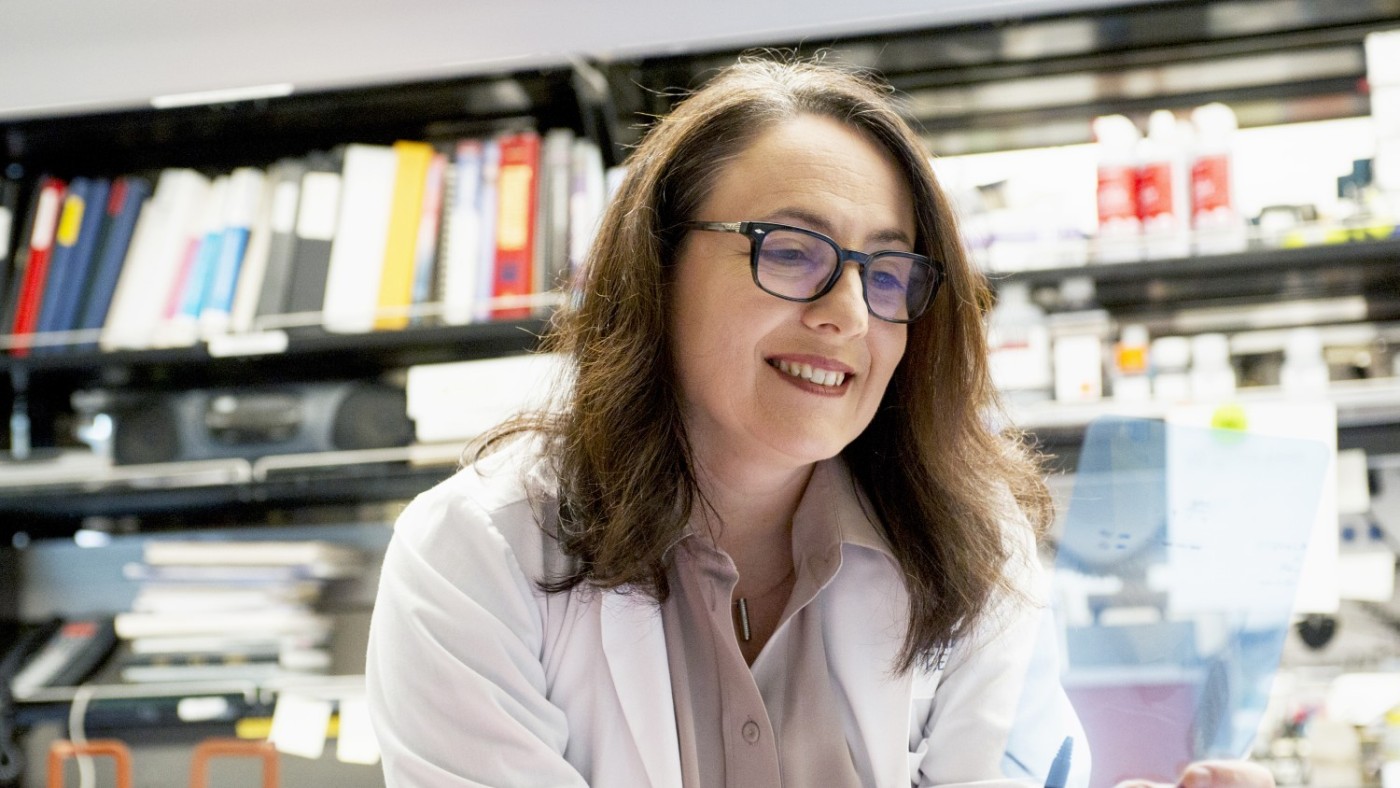
On October 1, 2025, it was announced that the Alzheimer’s Association has selected Gladstone Institutes’ Katerina Akassoglou, PhD, as a 2025 recipient of the Zenith Fellows Award, an international prize given annually to scientists making substantial contributions to the field of Alzheimer’s research. A senior investigator at Gladstone Institutes and director of the Gladstone-UCSF Center for Neurovascular Brain Immunology, Akassoglou has pioneered research into interactions between the brain, blood vessels, and immune system—and has shown how those interactions drive the development and progression of Alzheimer’s and other neurodegenerative diseases. “Katerina Akassoglou’s research exemplifies the type of bold, innovative science that brings us closer to effective treatments and, ultimately, a world without Alzheimer’s and other dementias,” says Heather Snyder, PhD, the Alzheimer’s Association’s Senior Vice President of Medical and Scientific Relations.
The Zenith Fellows Awards are among the most prestigious worldwide for Alzheimer’s and dementia science. With funding from Zenith Society members, the program has provided more than $48 million in awards to 152 leading Alzheimer’s researchers in nine countries since 1991.
The awards are supported philanthropically by members of the Alzheimer’s Association Zenith Society, who have an exceptional commitment to the advancement of Alzheimer’s and other dementia research. The society’s mission aligns closely with Gladstone’s Alzheimer’s program, which is dedicated to uncovering the root causes of neurodegeneration and advancing therapies that address disease mechanisms at their source.
Revealing the Role of Fibrin
Among Akassoglou’s most significant findings, she and her team discovered that Alzheimer’s, multiple sclerosis, and other neurological conditions share a common thread: a toxic immune reaction caused by blood that leaks into the brain through damaged blood vessels. She identified fibrin, a blood-clotting protein, as the culprit, hijacking the brain’s immune system and setting off a cascade of often-irreversible effects that result in damaged neurons.
With this knowledge, Akassoglou developed a new immunotherapy to neutralize the toxic effects of blood in the brain. A humanized version of the fibrin-targeting immunotherapy is now in clinical trials in patients with Alzheimer’s disease and diabetic macular edema. In mouse models, the therapy protected against neuroinflammation, neurodegeneration, and disease progression.
But this is only the start.
The Zenith Fellows Award provides $450,000 in research funding, which Akassoglou will use to unlock mechanisms of cerebrovascular dysfunction in Alzheimer’s disease.
Her studies will fill a major gap in knowledge—namely, the connections between blood vessel damage and neuron dysfunction in Alzheimer’s. This research seeks to uncover how our brain, immune system, and vascular systems communicate with each other, with the goal of developing novel approaches for treating disease.
“Our discoveries into the role of fibrin in Alzheimer’s and other neurological diseases are only the beginning,” Akassoglou says. “So much remains to be known about how our immune system and vasculature control brain-body communication. I look forward to deepening our understanding of these reciprocal connections that play a critical role in neurological disease.”
Enduring Leadership in Alzheimer’s Research
“The urgency of Alzheimer’s research has never been so great, with more than one in 10 people over the age of 65 living with the disease in the U.S.,” says Lennart Mucke, MD, director of the Gladstone Institute of Neurological Disease and a previous recipient of the Zenith Fellows Award. “But breakthroughs are happening, and Katerina’s research gives us hope. Due to her work, we may have treatments in the near future that target toxic pathways in the brain not addressed by any other drugs.”
Mucke adds that the latest Zenith Award to Akassoglou highlights the perfect match between the vision of the Zenith Society’s members and the groundbreaking science at Gladstone. In addition to Akassoglou and Mucke, now-retired Gladstone investigator Karl Weisgraber, PhD, also was a recipient of a Zenith Award, demonstrating Gladstone’s longstanding leadership in Alzheimer’s research.
Akassoglou has previously received many prestigious awards, including the highest honor from the National Multiple Sclerosis Society. She’s an elected lifetime fellow of the American Association for the Advancement of Science (AAAS), as well as a fellow of the National Academy of Inventors and the American Neurological Association, among other honors.