

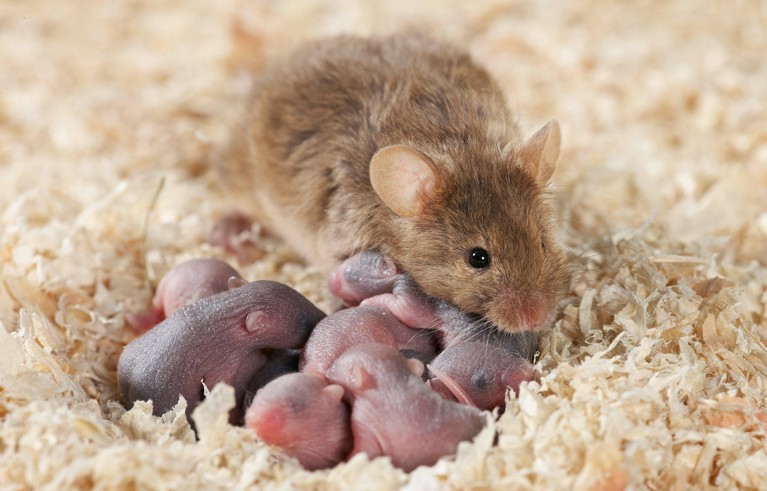
Inside a small enclosure, a mother mouse hears her lost pups crying. She swivels her head to look for the first baby, then darts over to retrieve it. With the distraught pup in her mouth, she scurries back to her nest. Moments later, she rushes to rescue the next one, repeating the process until all are piled together, warm and safe. “This is a pretty simple behavior,” says Cold Spring Harbor Laboratory (CSHL) Professor Stephen Shea, PhD. “But we’re finding that it actually has a rich neural control mechanism.” Shea has been studying the neuroscience behind pup retrieval for years, hoping to understand how the brain motivates behavior, learns over time, and responds to social cues. In a new article published in Current Opinion in Neurobiology, he brings together years of research to show that two well-known brain chemicals play surprisingly different roles in motivation. The open-access article is titled “Complementary Influences of Noradrenaline and Dopamine in Orchestrating a Motivated Social Behavior.”
“Dopamine and noradrenaline have all kinds of effects on mood, circadian rhythms, reward, arousal, and all sorts of things,” he says. “It’s really a tale of two neuromodulators.”
Noradrenaline and Motivation
Motivation plays a role in many learned behaviors, from solving puzzles to raising children. Yet, researchers have long struggled to tease apart the roles of noradrenaline and dopamine in motivated behavior. The two are often conflated because they share similar chemical structures and have overlapping functions in the brain. To learn more about these neuromodulators, the Shea lab turned to pup retrieval, a natural behavior that requires both motivation and learning.
Blind, deaf, and unable to regulate their own body temperatures, newborn mice are helpless when separated from their nest. They can only emit distressed vocalizations, hoping mom will come to the rescue. At first, new mothers don’t recognize the sound. However, over time, they become familiar with the distress calls and get quicker at running to them.
Shea didn’t initially set out to uncover the differences between neuromodulators, but an unexpected experiment result set him down the path of discovery.
Because noradrenaline gets released when something important happens, Shea expected signals to shift as mouse mothers improved their pup retrieval skills. To test this idea, Shea and his team used a system called fiber photometry to record the mouse brain in action. The team engineered mouse neurons to glow green when noradrenaline was released. To Shea’s surprise, although the mice became progressively more efficient at retrieval, noradrenaline remained stable across trials.
“That was unexpected,” Shea says. “We predicted exactly the opposite.”
The result pointed his team in another direction.
“That was what led us to look into dopamine, because we wanted to find some kind of dynamic signal,” he says. “We were also interested in social reward. There’s this idea that social rewards are processed similarly to actual rewards—like cake or money. Dopamine was a likely candidate to look at.”
Dopamine Tests
In similar experiments monitoring dopamine with optical fibers, Shea found the results he was looking for. Across the trials, pup retrieval speed increased over time while dopamine gradually declined in the moms’ brains. But Shea noticed another interesting pattern in the data. Dopamine rose and fell naturally as the mice interacted with their environment. Yet, these small changes in dopamine appeared to predict mouse speed in future trials.
“When I saw that result, I said, ‘I think we’ve got something here,’” he recalls.
The team inactivated mothers’ dopamine neurons during alternating trials to determine the chemical’s exact role in pup retrieval efficiency. If dopamine helped drive immediate performance, the team expected to see a prompt drop in pup retrieval speed. But the team saw no difference from one trial to the next. Instead, the mothers struggled to improve their speed across all trials.
“That’s where this idea of dopamine affecting future behavior really took flight,” Shea explains.
Still, exactly how the neuromodulator helps the brain learn over time was unclear. Reward prediction error, a leading concept in neuroscience, suggests dopamine likely signals a difference between expected and actual rewards rather than the reward itself. To see whether this system plays a role in maternal behavior, Shea and his colleagues carried out experiments in which they tricked mice during pup retrieval trials.
The researchers placed a mouse pup behind one of two closed doors and a mouse mother outside. In each trial, one of two tones played, and a door opened. About 90% of the time, one tone signaled that the pup was in the accessible chamber while the other signaled that the pup was inaccessible.
The researchers found that dopamine signals were higher when the mouse was surprised to find her pup. On the other hand, dopamine dropped slightly when the mother expected a pup and didn’t find one. Their results fit with the reward prediction error theory. Rather than dopamine spiking each time a mother reached her pup, it shot up only when that reward surprised her. Those dopamine spikes reinforced her retrieval behavior.
“Do It Now” or “Do It Better Next Time”
Together, the studies suggest that the two neuromodulators work together to motivate mothers to retrieve their pups quickly, but contribute in different ways. Noradrenaline helps the mother immediately respond to her pup’s distress, while dopamine helps increase her efficiency in the next trials. In other words, noradrenaline tells the brain to “do it now,” while dopamine signals “do it better next time.”
“This might have implications for everything from emotional regulation to sequence learning,” Shea says.
Before understanding how neurodevelopmental disorders like autism disrupt behavior, researchers need to know how healthy brains learn, make decisions, and respond to social cues. Shea’s lab hopes these discoveries could one day lead to a better understanding and treatment of certain brain disorders.
Their next challenge is to see how competing motivations might change a mother’s decision during pup retrieval. In the wild, moms might face a variety of rewards and obstacles while running to their kids. Shea is now planning experiments in an arena with “looming discs” that simulate hawks, physical barriers for the mice to run over, and food to distract them.
“Right now, we’re doing experiments with a crane where we take the pups and raise them up,” he says. “The mother has to run straight to the top of the crane to get the pup back. We’re interested in how things like effort, expectation, threat, and reward all get integrated to shape complex behavior.”
This posting is based on release was written by Margaret Osborne, Science Writer | publicaffairs@cshl.edu | 516-367-8455