

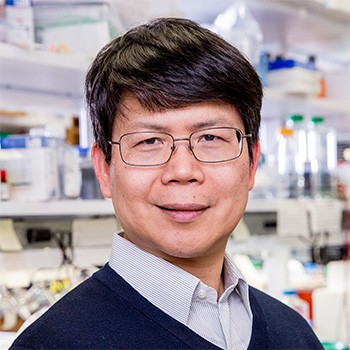
The 2024 Albert Lasker Basic Medical Research Award honors a scientist for the discovery of the cGAS enzyme that senses foreign and self DNA. With original thinking and tour-de-force experimentation, Zhijian “James” Chen (UT Southwestern Medical Center) solved the mystery of how DNA stimulates immune and inflammatory responses. cGAS underpins a major mechanism by which mammals combat microbial invaders and it fosters anti-tumor immunity. In certain physiological settings, inappropriate cGAS activity contributes to autoimmune and inflammatory disorders. The enzyme provides a pharmaceutical target for diverse human maladies, and the signaling molecule that it generates holds promise for fighting infectious diseases and cancer.
A DNA-Based Alarm
DNA blazes in textbooks as the canonical blueprint for life, but it serves other functions too. Normally, DNA in animals is confined to nuclei and mitochondria. DNA outside of these compartments—in the cytoplasm—warns that a microbial intruder has gained access, that malignant cells are present, or that some other pathological process is unfolding.
In 1908, Ilya Mechnikov noted in his Nobel Prize lecture that nucleic acid, comprised primarily of DNA, recruits a “protective army of phagocytes” to ward off microbes, though no one knew how. This cellular army belongs to the innate immune system, which mobilizes quickly when it spots pathogens, fending them off in general ways. It also awakens the B cells and T cells of the adaptive immune system, which take longer to deploy but zero in on the specific interloper at hand and “remember” what they have seen.
In 2006, researchers showed that delivering double-stranded DNA (dsDNA) to the cytoplasm of mammalian cells causes quantities of powerful components of the innate immune system to spike. These signaling molecules include type I interferons such as interferon-β, so named because they interfere with viral infection.
The discovery launched a race to unearth a cytoplasmic dsDNA detector that prompts manufacture of type I interferons. Several candidates were announced, but under scrutiny, they all faltered.
In 2008, Glen N. Barber (University of Miami School of Medicine) and Hong-Bing Shu (Wuhan University) independently identified a linchpin in the interferon pathway. This protein, which Barber named stimulator of interferon genes (STING), spurs cells to crank up production of type I interferons, and the following year, he reported that DNA instigates the process. However, despite STING’s importance, it does not directly sense DNA.
Biochemical Magnum Opus
Through a series of imaginative, elegant, and incisive studies, Chen unmasked the elusive sensor. He tracked it down using an open-ended approach that made no assumptions about its identity or properties, demanding only that it perform the function that he sought: dsDNA-dependent activation of STING.
First, he wanted to trap elements of the pathway that operate before STING swings into motion. Toward that end, Chen, together with postdoctoral fellow Lijun Sun and graduate student Jiaxi Wu, obliterated STING in mouse cells so that he would collect only stimulators, not downstream elements. The team put dsDNA into these STING-deficient cells and extracted their innards, reasoning that they would contain the presumptive activator. The researchers then applied this material to a second set of cells and measured STING mobilization by tracking the status of a protein that it fires up: a key interferon-β regulator, IRF3.
The cellular contents successfully galvanized IRF3, so the investigators knew that the substance they sought was somewhere in the crude mixture. To tease it out, they employed chromatographic techniques to separate the components; then they checked which ones could goad STING. Through sequential purification steps, they homed in on the chemical of interest.
Subsequent analysis identified this compound as cyclic GMP-AMP (cGAMP), a type of molecule never before seen in mammalian cells, in which two nucleotides—in this case, GMP and AMP—join together in a circle through two phosphodiester bonds. Chen’s group reported this finding in 2012 and confirmed that cGAMP possesses definitive properties of a STING activator: A synthetic version of the molecule induces interferon-β production inside mammalian cells grown in culture dishes, and infection of mammalian cells with a DNA virus but not an RNA virus generates elevated quantities of cGAMP. Furthermore, the cyclic dinucleotide binds to STING and depends on STING to rev up IRF3. From these experiments, Chen concluded that cytoplasmic DNA kicks off a cascade of events: cGAMP appears and prods STING, which propels IRF3 to turn on type I interferon and related genes.
Next, Chen wanted to track down the enzyme that manufactures cGAMP. With Sun and Wu, he mashed up cells that make cGAMP when provoked by DNA and segregated their constituents based on size, charge, and other characteristics. The investigators then tested each sample for the enzymatic behavior that they sought: the ability to make cGAMP if DNA is present. By choosing the most active fractions and subjecting them to further separation steps, they gradually enriched for the desired protein, casting off others in the process.
Eventually, Chen zeroed in on three proteins whose quantities peaked in the same fractions that exhibited maximum enzymatic strength. The predicted amino acid sequence of one was especially exciting: It resembled 2´-5´-oligoadenylate synthase, which belongs to the same family as adenylate cyclase, the enzyme that makes the classic signaling entity cyclic AMP. Perhaps, Chen reasoned, this newly discovered protein would function analogously to adenylate cyclase; instead of marrying two atoms within ATP to form cyclic AMP, it would attach atoms within GTP and ATP to each other and create cGAMP.
Chen isolated the gene that encodes the protein, which he named cyclic guanosine monophosphate (GMP)-adenosine monophosphate (AMP) synthase (cGAS), and showed that cGAS overproduction induces interferon-β in cells that contain STING, but not in those that lack it. Furthermore, altering portions of cGAS that are predicted to be crucial for catalysis, based on analogy with its molecular relatives, obliterates the ability to foment IRF3 activation.
By several strategies, Chen demonstrated that cGAS is essential in human and mouse cells for making cGAMP and inducing interferon-β upon encountering DNA or a DNA virus. Furthermore, purified cGAS binds DNA and performs the expected reaction, fabricating cGAMP from ATP and GTP if DNA is present. Together, the results established that cGAS senses dsDNA in the cytoplasm and generates cGAMP in response; cGAMP, in turn, rouses STING, which triggers type I interferon production through IRF3 (see Figure).
Blasting Off with cGAS
This work broke open a new field and, in short order, several groups confirmed and extended Chen’s conclusions. Within months, scientists including Chen worked out the structure of cGAS, and they elucidated how DNA switches on cGAS and cGAMP switches on STING, necessary steps in harnessing the pathway for therapeutic use.
Chen expanded our understanding of cGAS’s reach when he determined that the cGAS-cGAMP-STING pathway detects not only DNA viruses, but also retroviruses such as HIV, whose genetic material is composed of RNA. Inside host cells, the viral RNA is converted to DNA. Retroviruses are notorious for evading the innate immune response, but certain manipulations—compromising the integrity of the viral capsid, for instance, which makes it leak—can render HIV able to stir type I interferons and related molecules. Chen exploited such tricks and showed that cGAMP and STING underlie the process. Thus, under some conditions, cGAS can sense HIV and other retroviruses. These observations raised the possibility that administration of cGAMP might help bypass HIV’s knack for sidestepping the immune system.
Chen wanted to pin down the physiological relevance of cGAS, so he engineered mice that lack the gene to test whether the effects that he had unveiled in test tubes and cells extend to live animals. When infected with a DNA virus, the cGAS-deficient rodents displayed an unusually weak interferon response and more of them died than did their counterparts that carried normal amounts of cGAS. Additional experiments with injected cGAMP demonstrated that the signaling dinucleotide dramatically boosts antibody and T-cell reactions to foreign proteins.
These studies and others established that cGAS senses DNA viruses in live animals and sparks the innate immune system. We now know that a wide spectrum of microbial pathogens, including many intracellular bacteria, induce interferons through the cGAS-cGAMP-STING pathway. The ability of cGAMP to potently stimulate STING underscores the possibility of wielding the chemical to battle microbial scourges as well as cancer, as type I interferons have long been known to guard the body against malignancies.
Fueling Inflammation
Although the innate immune system benefits people when it foils invaders, its dark side manifests when the body attacks itself. Scientists had linked defects in an enzyme called Trex1, which chews up DNA in the cytoplasm, to human autoimmune diseases including Aicardi-Goutieres Syndrome and systemic lupus erythematosus that are characterized by elevated activity of interferon-stimulated genes. These reports implied that the failure to destroy cytoplasmic DNA spurs the interferon pathway. Mice that lack Trex1 similarly excite interferon-induced genes and die a few months after birth due to severe inflammation.
In 2015, Chen showed that eliminating cGAS in mice that lack Trex1 rescues the lethal effects of the missing enzyme and abolishes the tissue and molecular pathology that normally kills the animals. Independently, Daniel Stetson (University of Washington School of Medicine) published similar findings. These results indicated that cGAS drives the detrimental effects caused by the absence of Trex1, and they suggested that thwarting cGAS might curb autoimmune diseases such as lupus, in which self DNA agitates the interferon pathway.
cGAS has been implicated not only in autoimmune conditions, but in numerous inflammatory illnesses, including age-related macular degeneration and neurological disorders such as Parkinson’s disease, Alzheimer disease, and amyotrophic lateral sclerosis (ALS). Calming the cGAS-cGAMP-STING pathway might therefore provide benefit across a broad span of ailments. These possibilities have ignited intense interest by pharmaceutical companies, which are attempting to develop agents that inhibit cGAS. On the flip side, because cGAS furnishes the first line of defense against dangerous human pathogens and contributes to anti-tumor immunity, enhancing the pathway in other physiological situations might bolster health.
Through creative and elegant investigations, Chen has delivered foundational insights that explain how our bodies stay safe in the sea of microbes around us and that illuminate mechanistic details of manifold illnesses. The impact of his work reverberates far beyond clinical biomedical science. cGAS-like enzymes guard thousands of bacterial species against the spread of their own viral-like menaces, bacteriophages. The system shines as an ancient evolutionary scheme for repelling would-be cellular hijackers that threaten to co-opt another’s resources to further their own domination.
This posting is from a release written by Evelyn Strauss.